
Fort Bend County Veteran Community Profile
An integrated geospatial assessment identifying veteran population characteristics, economic conditions, and community profiles to support veteran-serving organizations.
MADforVets sought to better understand where veterans reside throughout Fort Bend County and how demographic, economic, and housing conditions vary across veteran communities. Gold Axis developed a countywide spatial assessment integrating veteran demographics, household income, housing indicators, disabled veteran property exemptions, and federally designated low- and moderate-income areas into a unified geographic intelligence framework. The assessment provided an objective understanding of veteran community characteristics to support outreach planning, program development, and future funding initiatives while intentionally excluding organizational strategy or site selection recommendations.
Planning Insights
Veteran Communities Are Unevenly Distributed Across the County
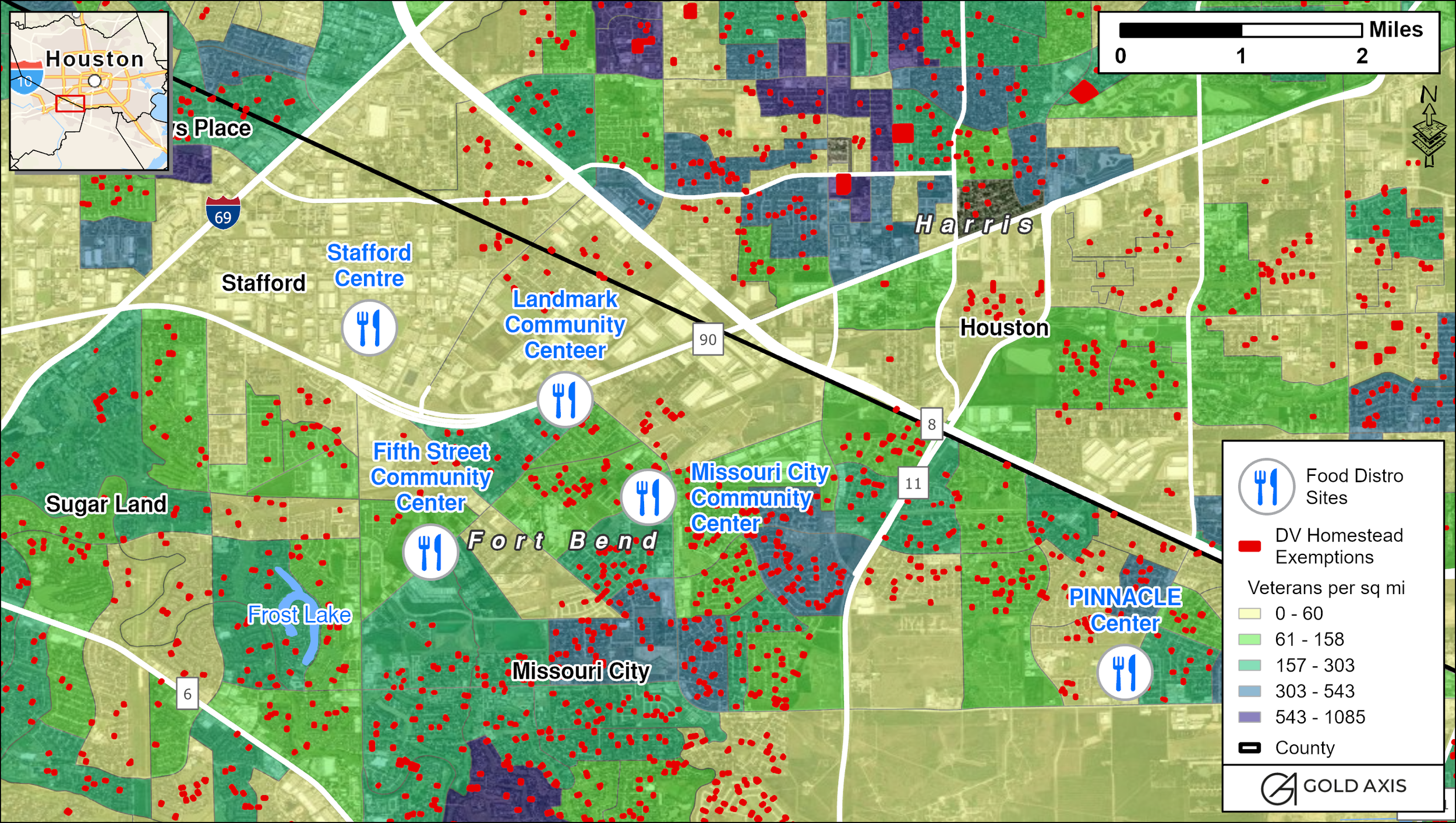
Veteran population density and veteran population percentage were analyzed independently to distinguish where veterans are most concentrated from where they represent the largest share of the local population. Together, these analyses identified distinct veteran communities that may require different outreach strategies.
Economic Conditions Vary Across Veteran Communities
Median household income and HUD Low- and Moderate-Income (LOWMOD) data were integrated with veteran population estimates to provide economic context. Comparing these datasets identified communities where veteran households may experience greater financial pressures while also highlighting areas with stronger economic conditions.
Administrative Records Complemented Census Estimates
Disabled Veteran (DV) Homestead Exemptions from the Fort Bend County Appraisal District were incorporated as an administrative indicator of owner-occupied disabled veteran households. Density mapping and heatmap analysis complemented Census-based estimates by revealing localized clusters of veteran households that may not be apparent through demographic data alone.
Regional Profiles Supported Community-Based Planning
The county was evaluated as three distinct veteran community profiles—North Fort Bend, Central Fort Bend, and East Fort Bend. Each region was characterized by different combinations of veteran concentration, household income, housing conditions, and socioeconomic characteristics, providing organizations with a framework for tailoring outreach and programming to the needs of individual communities rather than treating the county as a single market.
Technical Approach
Gold Axis integrated American Community Survey (ACS) demographic estimates, HUD Low- and Moderate-Income Summary Data (LMISD), Fort Bend County Appraisal District disabled veteran homestead exemptions, and other publicly available federal, state, and local datasets into a unified geospatial analytical framework. Spatial analysis was used to evaluate veteran population density, demographic significance, age cohorts, economic conditions, and administrative indicators of veteran households. The resulting assessment combined thematic mapping, regional profiling, and spatial analysis to produce executive-ready decision support products for nonprofit planning and community engagement.