
Harris County Housing Stability & Homelessness Risk Assessment
An integrated spatial risk model evaluating housing instability and homelessness vulnerability across Harris County.
Gold Axis developed a countywide housing stability assessment to identify neighborhoods most vulnerable to housing instability and homelessness. Rather than estimating the current homeless population, the study examined the underlying socioeconomic conditions that increase housing vulnerability by integrating housing affordability, income, poverty, SNAP participation, unemployment, and demographic data into a composite Homelessness Risk Index. The assessment provided policymakers and community organizations with a data-driven framework for identifying where risk is concentrated, understanding the factors driving vulnerability, and prioritizing future interventions.
Planning Insights
Housing Affordability Is the Primary Driver of Risk
Analysis found that housing cost burden consistently aligned with the highest-risk communities. Many neighborhoods experiencing elevated housing instability were characterized by households spending more than 30 percent of their income on housing, demonstrating that affordability—not unemployment alone—was the strongest predictor of increased risk.
Financial Stress Reinforces Housing Vulnerability
Communities with high SNAP participation frequently overlapped with neighborhoods identified as high risk. The analysis showed that existing dependence on public assistance often coincided with broader economic pressures, indicating reduced household financial resilience.
Risk Increased Between 2020 and 2024
Comparing baseline conditions in 2020 with updated 2024 estimates revealed that housing instability increased across many areas of Harris County. Change detection analysis highlighted neighborhoods where vulnerability intensified over time, providing an additional layer of intelligence for long-term planning and resource allocation.
Housing Instability Is Concentrated in Distinct Geographic Clusters
The Homelessness Risk Index identified neighborhoods where multiple socioeconomic pressures overlap, creating compounded housing vulnerability. Rather than relying on a single indicator, the model evaluated the interaction between several economic and housing variables to identify areas facing the greatest overall risk.
Technical Approach
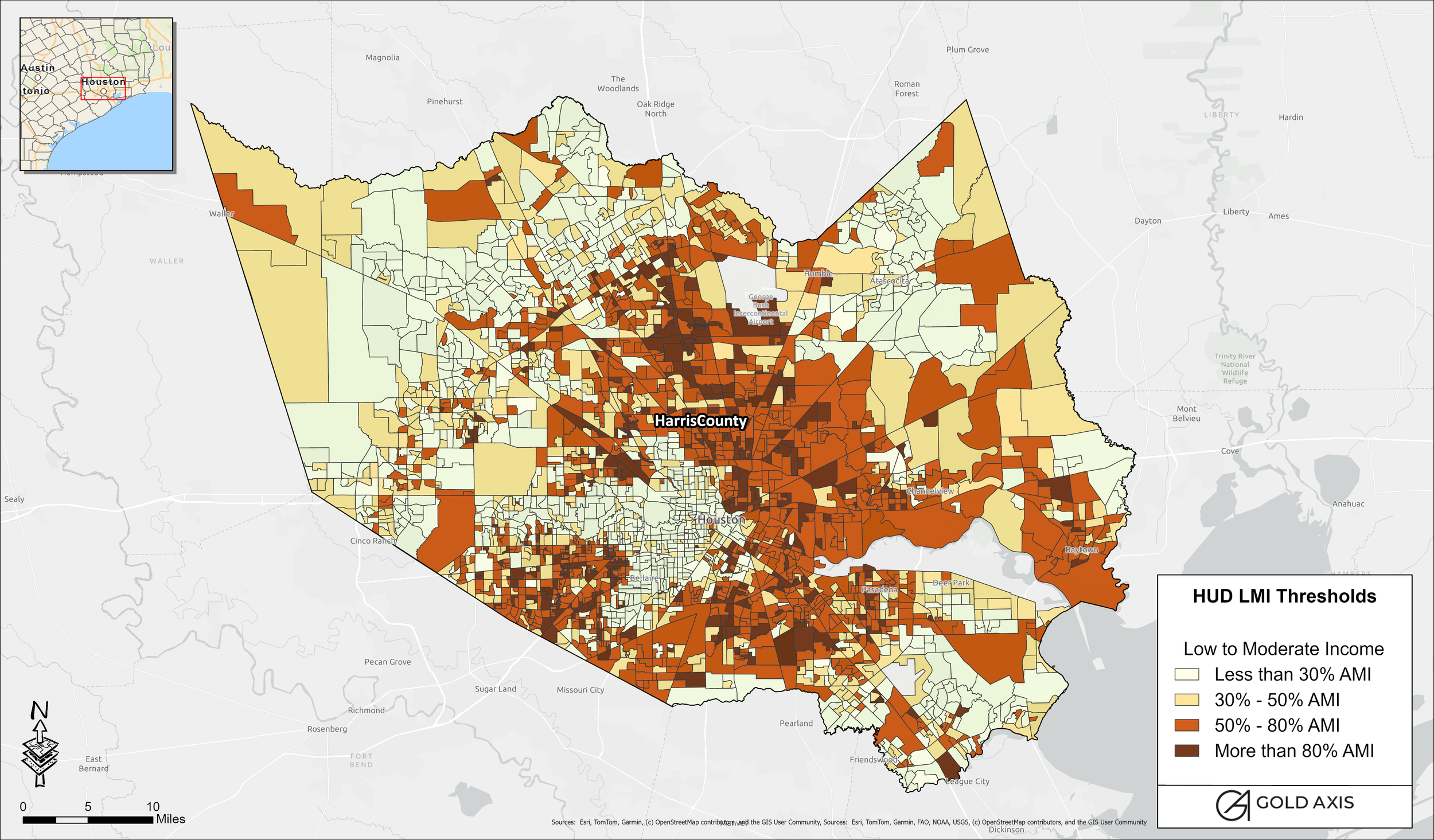
Gold Axis developed a composite Homelessness Risk Index by integrating American Community Survey demographic estimates, housing affordability indicators, SNAP participation, unemployment, poverty, household income, and HUD Low-to-Moderate Income (LMI) data into a unified geospatial analytical framework. Risk scores were calculated for Census Block Groups, allowing baseline conditions, temporal change, contributing factors, and the overall scale of need to be visualized through thematic mapping and executive-ready decision support products.